
Why some brands show up in AI and others don't

planeed.app
Semantic Brand Architecture
AI Visibility
Relations of AI Visibility
isPartOf
Blogbeitrag | AI Word of Mouth
Relations of Blogbeitrag | AI Word of Mouth
about
- DefinedTerm: https://planeed.org/planeedapp/topics/ai-visibility
Blogbeitrag | Beyond the click
Relations of Blogbeitrag | Beyond the click
about
- DefinedTerm: https://planeed.org/planeedapp/topics/ai-visibility
Blogbeitrag | It's no longer about ranking. It's about being Retrieved
Relations of Blogbeitrag | It's no longer about ranking. It's about being Retrieved
about
- DefinedTerm: https://planeed.org/planeedapp/topics/ai-visibility
Blogbeitrag | The Legal Layer of AI visibility
Relations of Blogbeitrag | The Legal Layer of AI visibility
about
- DefinedTerm: https://planeed.org/planeedapp/topics/ai-visibility
Blogbeitrag | Why some brands show up in AI and others don't
Relations of Blogbeitrag | Why some brands show up in AI and others don't
about
- DefinedTerm: https://planeed.org/planeedapp/topics/ai-visibility
LN | WKO Kärnten - DIGI talk "Von SEO zu GEO" (20.07.26)
Relations of LN | WKO Kärnten - DIGI talk "Von SEO zu GEO" (20.07.26)
about
- DefinedTerm: https://planeed.org/planeedapp/topics/ai-visibility
MBF Artikel | GEO statt SEO
Relations of MBF Artikel | GEO statt SEO
about
- DefinedTerm: https://planeed.org/planeedapp/topics/ai-visibility
WKO | DIGI.talk: Von SEO zu GEO
Relations of WKO | DIGI.talk: Von SEO zu GEO
about
- DefinedTerm: https://planeed.org/planeedapp/topics/ai-visibility
Bernhard Liebl, M.Sc.
Relations of Bernhard Liebl, M.Sc.
knowsAbout
- DefinedTerm: https://planeed.org/planeedapp/topics/ai-visibility
Dr. Aly Sabri
Relations of Dr. Aly Sabri
knowsAbout
- DefinedTerm: https://planeed.org/planeedapp/topics/ai-visibility

AI systems recommend brands they trust. Here’s what AI visibility means, why it matters for your business and what you can do about it.
Something is quietly reshaping how businesses get found, evaluated and chosen. And most marketing teams haven’t caught up with it yet.
When someone today wants to know which software to buy, which agency to hire, or which solution fits their problem, they increasingly ask an AI. ChatGPT, Perplexity, Gemini, Copilot- These tools are now a primary starting point for research and decisions. And when someone asks them a question about your industry, they give an answer. They recommend specific brands. They describe specific solutions.
The question worth asking is: is your company in that answer? Or is it a competitor?
AI systems are making brand recommendations every day, at scale, in conversations you’ll never see. Whether your brand appears in those conversations – or doesn’t – is not random. It follows a logic. And that logic can be understood and acted on.
AI Doesn’t Search. It Recommends.
To understand AI brand visibility, the first thing to grasp is how different it is from traditional search. When someone searches on Google, they get a list of links. They click, they browse, they form their own view. Your job as a brand is to appear in that list – and then convince the person who arrives on your page.
AI works differently. When someone asks an AI a question, they get an answer. Not ten options – an answer. The AI has already done the evaluation. It has already decided which brands are relevant, credible and worth mentioning. By the time the user reads the response, the recommendation has already been made.
This means the competitive moment has moved earlier. The battle for visibility is no longer just on your website or in a search ranking. It happens inside the AI’s understanding of your brand – before a user ever asks their question.
So How Does an AI Decide Which Brands to Trust?
This is the question that sits at the heart of AI brand visibility. And the answer, once you understand it, is surprisingly intuitive. AI systems build up a picture of the world from the information they process. Every company, product and brand exists in that picture as a kind of entry – with associated descriptions, topic areas and credibility signals. When a user asks for a recommendation, the AI consults that picture and surfaces the brands it has the clearest, most confident understanding of.
The brands that get recommended are the ones the AI understands well. The ones that have been described consistently, associated clearly with specific topics and positioned coherently across many different sources. In short: the brands that have made themselves easy to understand.
The brands that get skipped are the ones the AI is unsure about. Maybe they’ve been described differently in different places. Maybe their positioning is vague. Maybe they’ve produced a lot of content but it doesn’t add up to a clear picture of what they actually stand for.
It’s not the loudest brand that gets recommended. It’s the clearest one.
The Four Things AI Looks For
There are four factors that consistently determine whether a brand earns a confident mention in AI-generated responses. None of them are technically complex, but all of them require intention.
- Clarity about who you are. Does the AI have a consistent, stable understanding of what your company does and what category it belongs to? Or does your brand get described differently depending on where the AI encountered it? Inconsistency here is one of the most common reasons brands get overlooked.
- A clear topic territory. Is your brand strongly associated with specific topics, topics you return to consistently, with depth and a recognizable point of view? AI systems reward focus. A brand that is genuinely known for something specific will always outperform one that tries to cover everything.
- Clear relationships. Does the AI understand who your brand is for, what problems it solves and how it fits into its category? These connections need to be explicit, not implied. An AI doesn’t infer positioning, it reads the signals that are actually there.
- Connected sources. AI systems don’t form their understanding from a single webpage. They aggregate signals from your website, your content, third-party mentions, partner sites and more. If those sources are connected and structured around a coherent story, the AI’s confidence in your brand grows. If sources are fragmented and inconsistent, it doesn’t.
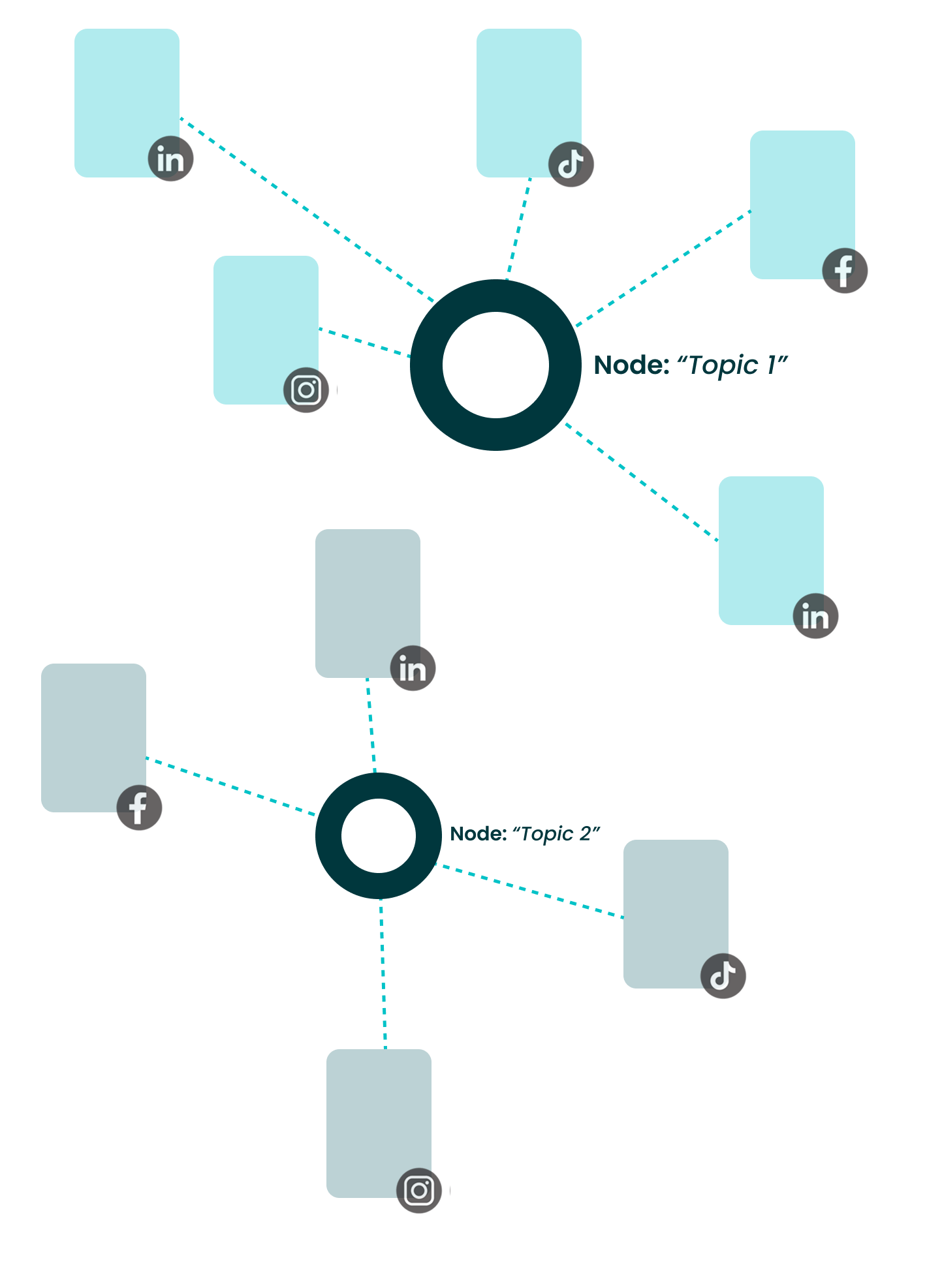
These four factors are not a checklist to complete once. They describe an ongoing state – the quality of the signal your brand is continuously emitting. And that signal is either building your AI visibility or quietly undermining it.
Why This Is a Business Issue, Not Just a Marketing One
It is tempting to think of AI visibility as a technical SEO concern. Something to hand off to a specialist and move on. But the business implications are more direct than that.
Think about where buying decisions start. A procurement team researching vendors. A founder exploring solutions to a new problem. A manager trying to understand what options exist in a category. These conversations are increasingly happening with AI systems first. The brands that appear in those conversations get considered. The ones that don’t, don’t.
This is not a future scenario. It is the current reality for a growing share of B2B and B2C decisions. And the gap between brands that are clearly represented in AI and those that aren’t will only widen as AI tools become more embedded in everyday workflows.
More practically: AI visibility compounds. A brand that builds clear, consistent signals now will be increasingly easy for AI systems to recommend as more data accumulates. A brand that ignores this will find the gap harder to close the longer it waits. Because the AI’s picture of that category is already being shaped by competitors who moved earlier.
More Content Is Not the Answer
When marketers first hear about AI visibility, the instinct is often to produce more – more articles, more pages, more presence. But volume is not the variable that matters here.
In fact, more content without a clear underlying strategy can make things worse. If your brand is already sending mixed signals, adding more content to the pile only adds more noise. The AI’s picture of your brand becomes broader but no clearer.
What matters is not how much you publish, but how coherently everything you publish adds up. Does it consistently reinforce what your brand stands for? Does it build a recognizable association with the topics you want to own? Does it say the same things, in the same terms, across different channels and formats?
That kind of coherence doesn’t require a massive content operation. It requires a clear strategy and a deliberate approach to how your brand presents itself. One that treats every piece of communication as part of a larger, connected picture rather than a standalone output.
The brands that win at AI visibility are not the ones publishing the most. They’re the ones where everything they publish points in the same direction.
What planeed Does
planeed is built to solve exactly this problem – and to make it manageable for any marketing team, regardless of size or technical background.
At its core, planeed helps brands build the kind of clear, coherent presence that AI systems recognize and trust. That means defining the topics a brand should genuinely own, structuring content so that it builds connected expertise rather than isolated articles and ensuring that positioning used across a brand’s communications are consistent enough to send a strong, unified signal.
The goal is to make AI visibility something you can actively manage, not something that happens to you. Because the brands that understand this shift and act on it now are the ones that will show up in the AI-generated conversations shaping decisions in their market.
The Window Is Open. Not Forever.
Every major shift in digital visibility has created a window, a period when the rules are still being established and early movers earn an advantage that becomes increasingly hard to displace.
We have been here before. The brands that invested in search visibility early built positions their competitors spent years trying to close. The ones that moved early on social media shaped the conversations in their categories for a decade.
AI visibility is that moment, right now. The picture AI systems have of your category is forming. The reference points are being set. The brands that make themselves clearly understood today will be the ones recommended tomorrow. And the ones that are hardest to dislodge once those patterns solidify.
The question isn’t whether AI visibility matters for your brand. It’s whether you’re building it – or leaving that ground to someone else
Related Posts