

For more than a decade, digital communication has followed a simple logic: more content, more channels, more campaigns, more tools. To scale and boost presence was the most important goal. With this logic, marketing teams expanded, martech stacks grew and content pipelines accelerated.
Every organization learned how to publish at scale. And yet, despite this exponential increase in activity, one thing did not scale accordingly: structural authority.
Campaigns perform. Traffic spikes. Visibility fluctuates. But true, durable dominance in a defined thematic space remains rare. Most brands are visible, but very few are structurally authoritative.
This is not a performance problem.
It is an architectural one.
The Illusion of Progress
The industry often confuses motion with progress. When metrics move, dashboards light up and engagement increases, it feels like growth. But in reality, most communication ecosystems are fragmented by design.
- Content is organized by channel
- Budgets are allocated by campaign
- Success is measured by asset
Each initiative may be optimized locally. Yet very few organizations ensure that every signal strengthens the same semantic foundation. The result is predictable: visibility peaks, then resets. Authority fluctuates instead of compounding and knowledge remains distributed instead of consolidated.
In an environment that increasingly evaluates entities, relationships and structured context, this fragmentation becomes strategically expensive.
The Structural Mismatch
Search engines, AI systems and digital knowledge environments do not think in campaigns. They interpret meaning through entities and their relationships.
- They connect signals.
- They map context.
- They evaluate consistency over time.
Most brands however still communicate in silos. This is the structural mismatch of our time:
external systems operate on entity logic, while internal communication remains campaign-driven.
The consequence is subtle but significant. Brands invest heavily in output without building a coherent semantic core. They generate activity without constructing infrastructure.
From Campaign Logic to Entity Logic
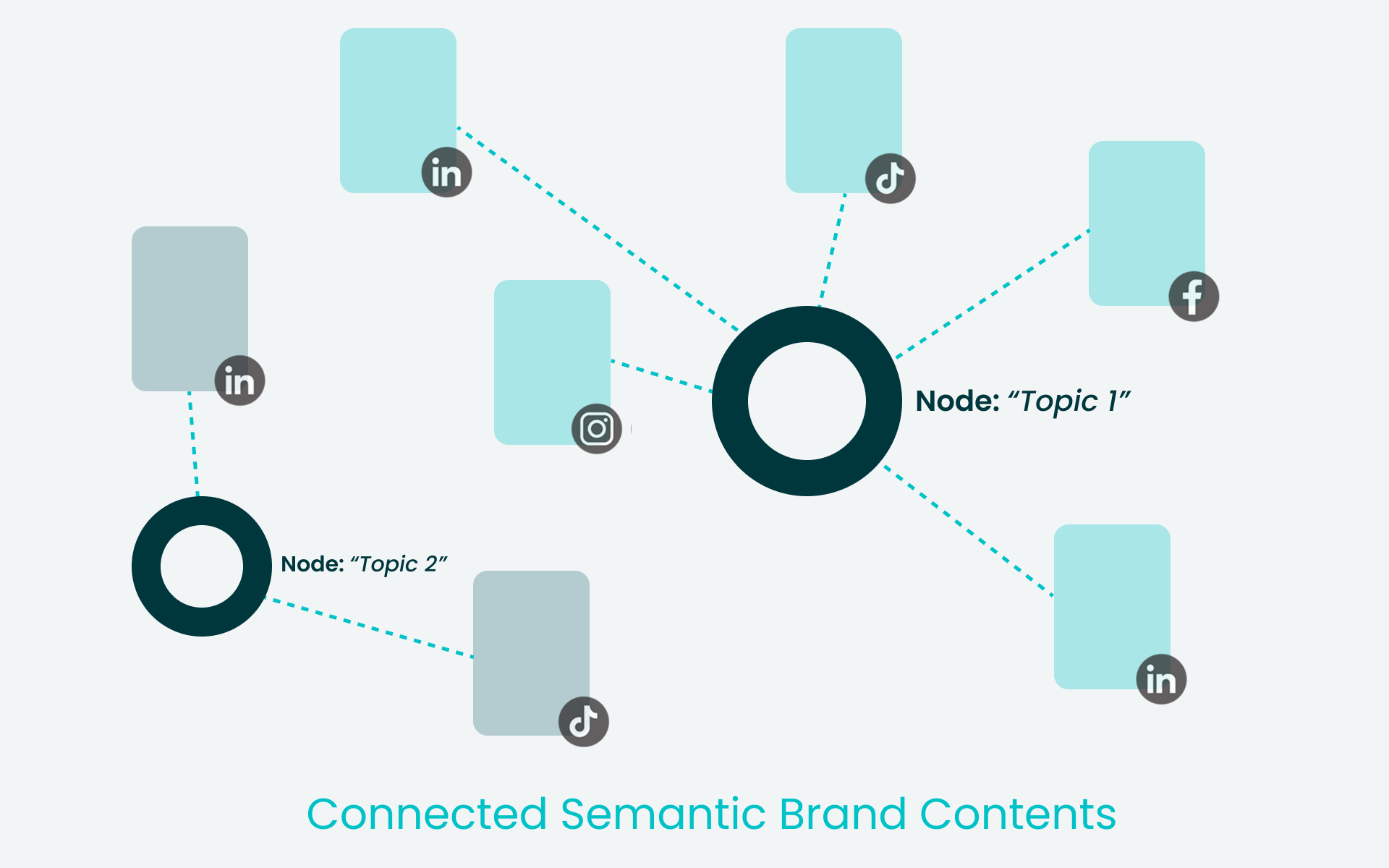
The next evolution in brand communication is not about producing more. It is about organizing differently. Instead of structuring communication around formats, platforms or short-term initiatives, organizations must define and strengthen clear semantic entities: their key products, solutions, technologies and other strategic themes.
Every relevant signal should reinforce these entities in a deliberate and interconnected way.
Not loosely.
Not occasionally.
But structurally.
When communication is organized around entities rather than campaigns, something changes fundamentally. Signals begin to accumulate, authority compounds and positioning stabilizes.
Communication stops being a series of activities and becomes a system.
Communication as Infrastructure
This is where a new category emerges. We call it Semantic Brand Infrastructure. This Infrastructure is not visible in the same way as campaigns. It does not trend, it does not spike, it provides stability, scalability and coherence.
Semantic Brand Infrastructure introduces a structural layer that consolidates communication around defined entities. It connects signals across channels and over time. It enables meaning to accumulate rather than disperse.
The Semantic Brand Hub is the operational expression of this principle: a central semantic nucleus that anchors all relevant communication and allows authority to compound.
This is not another optimization technique. It is an architectural shift.
Why This Shift Is Inevitable
The digital ecosystem is accelerating. AI-driven systems increasingly rely on contextual relationships. Search has evolved from keywords to entities. Content volume continues to grow exponentially.
In such an environment, fragmentation becomes a liability. The more content is produced without structure, the more diluted authority becomes. Organizations that continue to optimize in isolation will work harder for diminishing structural returns. Those who build infrastructure will experience compounding effects.
The difference will not be incremental. It will be structural.
The Emerging Standard
Every digital era has introduced a new foundational layer. Protocols enabled the web, platforms enabled distribution, automation enabled scale. The next foundational layer is semantic consolidation. Brands will not compete on who publishes the most. They will compete on who structures the best.
The companies that understand this early will define their domains. The rest will continue optimizing fragments and wondering why authority never truly accumulates.
The structural gap is visible: The question is no longer whether it exists — but who will close it first.
Related Posts
Related Posts
Enhancing CSR Communication with Sentiment Tracking In today’s socially conscious world, Corporate Social Responsibility (CSR) has become a fundamental aspect of brand …
To effectively leverage the synergy between CSR branding and HR excellence, business leaders must adopt a strategic approach that ensures these two …
Imagine a world where companies move beyond the confines of annual CSR reports, embracing a new standard of real-time, dynamic communication. Traditional …