Why every GEO Project needs a foundation before it needs content

planeed.app
Semantic Brand Architecture
Brand Knowledge Management
Relations of Brand Knowledge Management
isPartOf
planeed Workspace
Relations of planeed Workspace
relatedTo
Blogbeitrag | The Semantic OS
Relations of Blogbeitrag | The Semantic OS
about
Blogbeitrag | The new Marketing Layer no one is managing yet
Relations of Blogbeitrag | The new Marketing Layer no one is managing yet
about
Blogbeitrag | The structural gap in modern brand communication
Relations of Blogbeitrag | The structural gap in modern brand communication
about
Blogbeitrag | Why Semantic Brand Architecture must exist
Relations of Blogbeitrag | Why Semantic Brand Architecture must exist
about
Blogbeitrag | Why content optimization without a Semantic Foundation is building on sand
Relations of Blogbeitrag | Why content optimization without a Semantic Foundation is building on sand
about
LN | planeed (08.08.26)
Relations of LN | planeed (08.08.26)
about
Bernhard Liebl, M.Sc.
Relations of Bernhard Liebl, M.Sc.
knowsAbout
Dr. Aly Sabri
Relations of Dr. Aly Sabri
knowsAbout
Build the authority AI can understand and recommend.
Relations of Build the authority AI can understand and recommend.
about
We do not optimize campaigns. We redefine the infrastructure underlying all digital brand interaction.
Relations of We do not optimize campaigns. We redefine the infrastructure underlying all digital brand interaction.
about

GEO agencies are building the future of AI visibility. But most projects start one step too late. Here’s the missing layer — and why fixing it changes everything.
Generative Engine Optimization is having its moment. Agencies across the world are building practices around it. Marketing leaders are asking for it. And the underlying insight is correct: if AI systems increasingly shape how brands get discovered and recommended, then optimizing for those systems is not optional.
But there is a problem quietly undermining a lot of GEO work. And it’s not the quality of the content being produced. It’s what happens — or doesn’t happen — before a single word is written.
Most GEO projects start with content optimization. They should start with a company graph.
The Step That's Missing
A typical GEO project follows a recognizable flow. Discovery workshop. Visibility check and topic research. Content clustering. Brief creation. Production. Schema markup. Monitoring. It’s a reasonable structure and, executed well, it produces results.
What it rarely includes is a foundational step that should precede all of it: building a shared semantic model of the company itself.
Not a brand guide. Not a messaging document. Not a tone-of-voice framework. Those exist already in most organizations, and they serve a different purpose.
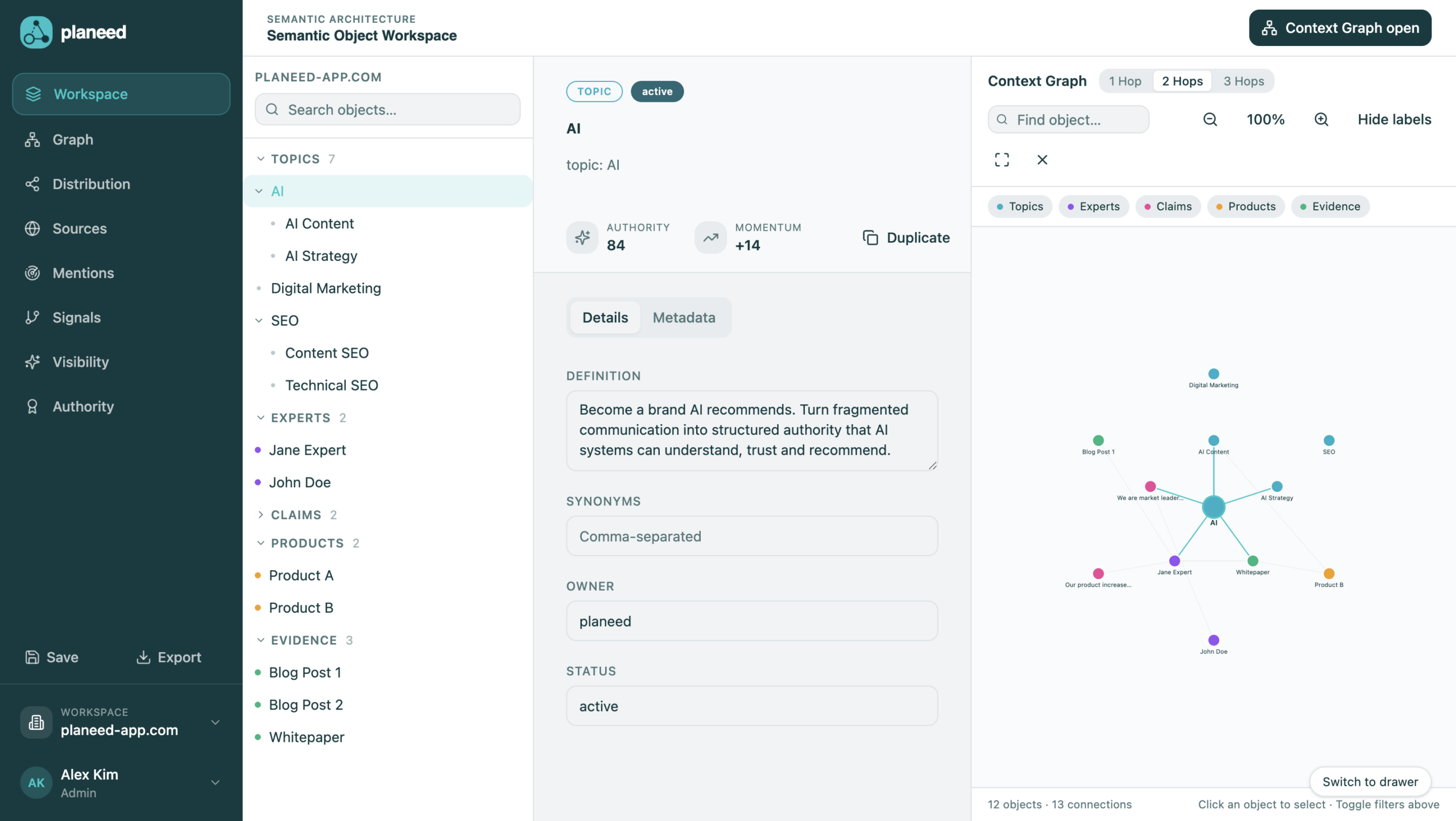
A semantic model is something more specific: a structured, interconnected definition of what the company is – its core topics, its products and services, its experts and their areas of authority, its key claims and the contents that support them. Mapped explicitly. Stored in one place. Accessible to every person and tool working on the project.
Without this foundation, GEO work is built on sand. Content gets produced that’s consistent with itself but inconsistent with other content. Topic clusters get defined without a clear sense of which ones the brand actually has the authority to own. Experts get associated with subjects they haven’t actually addressed. Entities shift names between documents. Claims appear in one channel and are absent from another.
Each of these is a small problem on its own. Together, they produce a fragmented signal. And AI systems, which aggregate signals to form their understanding of a brand, reward coherence and penalize fragmentation.
The Five Bottlenecks GEO Agencies Face
When we talk to agencies running GEO and AI visibility projects, five specific bottlenecks come up repeatedly. Understanding them explains why the missing foundation matters so much in practice.
- Structure before content.
The GEO workflow typically begins with visibility checks and content planning. But without a prior understanding of the brand’s semantic territory – which topics it genuinely owns, how its products and expertise areas relate, where its authority actually sits – content planning becomes educated guesswork. The result is content that is individually competent but collectively incoherent. An AI system processing that content will not form a confident picture of the brand’s authority in any particular domain.
- Scattered client knowledge.
Every agency deals with this: the knowledge that defines a client’s business is distributed across a dozen different tools and formats. Miro boards, Notion pages, old PowerPoints, Excel files, email threads, expert interviews that were never systematically documented. Reconstructing that knowledge at the start of a project costs weeks. Maintaining consistency across it throughout a project is even harder. The result is not just inefficiency. It’s structural inconsistency that flows directly into the content and undermines the authority signals the project is trying to build.
- Briefing inefficiency.
A content writer joining a GEO project needs to understand the company’s products, its target audiences, its experts, its core claims, and its competitive context before writing a single word. Without a structured model of the brand to reference, that onboarding takes weeks per person. Multiply that across a team, and across multiple clients, and it becomes one of the most significant hidden costs in an agency’s operation. It also creates a consistency risk every time a new team member interprets the brand differently from their predecessor.
- Structural inconsistency.
A product name that differs between the website and a white paper. An expert who is prominently featured in one topic cluster and completely absent from another. A claim that appears in a blog post but contradicts a statement in a case study. These inconsistencies are common in organizations that produce content across multiple teams and channels, and they are extremely difficult to spot without a structural view of the brand’s entity landscape. An AI system processing these signals will form an ambiguous picture of the brand – exactly the opposite of what GEO work is trying to achieve.
- Scalability.
Without a shared foundation, every new GEO project essentially starts from scratch. New client means new discovery process, new documentation, new knowledge reconstruction. This limits how efficiently an agency can scale its practice, how quickly it can onboard clients and how consistently it can deliver results. A foundation that persists and grows – where each new piece of content connects to an existing entity model rather than being created in isolation – changes the economics of the practice entirely.
What GEO Actually Needs: A Semantic Workspace
The answer to these five bottlenecks is not more software. Agencies already have project management tools, content calendars, reporting dashboards and analytics platforms. Adding to that stack doesn’t solve the underlying problem.
What’s missing is a specific type of foundation: a shared semantic workspace where the knowledge model of a brand lives, is maintained and is accessible to every person and system working on the project.
Not a Jira board. Not a Confluence wiki. Not a CMS. Something more specific and more structured: a place where the relationships between a brand’s topics, products, experts, claims and sources are explicitly defined and consistently maintained.
When that foundation exists, the entire GEO project changes. Contents aren’t produced in isolation – they reference an architectural layer that already exists. New team members don’t spend weeks reconstructing the brand – they see the architecture. Inconsistencies become visible immediately because the architecture makes relationships explicit. And every new piece of content produced strengthens the same coherent signal rather than adding to an unstructured pile.
The foundation doesn’t replace GEO work. It makes every part of GEO work faster, more consistent and more effective.
What This Means for Agencies Considering planeed
planeed was built to be exactly this foundation. Not a GEO tool. Not a content platform. Not a reporting dashboard. The semantic workspace where the knowledge model of a brand is defined, maintained and made available to every team member and tool working on AI visibility.
For a GEO agency, adopting planeed doesn’t mean replacing anything in your current stack. It means adding the layer that was missing from the beginning of the stack – the structured foundation that makes all of your existing tools and workflows more effective.
In practice, it changes five things:
- Projects start faster because the discovery phase has a structured output, not just a workshop document.
- Briefs take hours instead of weeks because the knowledge model already exists and writers can reference it directly.
- Inconsistencies get caught because the relationships between entities are visible in the model, not hidden across disconnected documents.
- Results compound because each new piece of content reinforces the same semantic structure rather than starting from zero.
- The agency scales because the foundation persists and grows rather than being rebuilt for every new client.
The questions planeed helps answer are, in the end, simple: Which topics does this brand own? Which products belong to which expertise areas? Which experts speak to which subjects? Which sources support which claims? What’s still missing?
Answering those questions well, for every client, is the foundation of effective GEO work. And it’s what planeed is built to make systematic, consistent and scalable.
The Right Moment to Build This
GEO as a discipline is still in its early stages. Agencies are building their practices now, defining their methodologies, establishing the processes that will determine how efficiently and effectively they can serve clients at scale.
The agencies that build the right foundation now – that add the semantic layer to the beginning of their project structure rather than continuing to start from keywords and content plans – will be the ones delivering more consistent results with less rework, onboarding clients more quickly and scaling their practices more efficiently.
That’s not a marginal advantage. It’s a structural one. And like all structural advantages, it compounds over time.
Related Posts